Where Are the Coal Mines in Benton, Il

Coalfields of the U.K. in the 19th century
Coal mining in the United Kingdom dates back to Roman times and occurred in many diametrical parts of the country. Britain's coalfields are associated with Northumberland and Durham, North and South Wales, Yorkshire, the Scottish Central Whang, Lancashire, Cumbria, the East and West Midlands and Kent. Later 1972, coal mining quickly collapsed and had practically disappeared by the 21st century.[1] The consumption of coal – mostly for electricity – fell from 157 million tonnes in 1970 to 18 cardinal tonnes in 2016, of which 77% (14 million tonnes) was foreign from Colombia, USS, and the Married States.[2] Employment in coal mines fell from a to of 1,191,000 in 1920 to 695,000 in 1956, 247,000 in 1976, 44,000 in 1993, and to 2,000 in 2015.[3]
Almost all onshore coal resources in the U.K. pass off in rocks of the Carboniferous age, about of which extend under the North Deep-sea. Bituminous coal is present in most of United Kingdom of Great Britain and Northern Irelan's coalfields and is 86% to 88% C. In Federal Ireland, in that location are extensive deposits of lignite which is less vigour-dense based on oxidization (burning) at ordinary combustion temperatures (i.e. for the oxidation of carbon – see fossil fuels).[4]
The last low-pitched ember mine in the UK closed on 18 December 2015. Twenty-six open cast mines still remained operative at the end of 2015.[5] Banks Minelaying said in 2018 they planned to start mining a new site in County Durham[6] simply in 2020 closed a major open cast site, Bradley mine, almost Dipton in the county[7] and the last open cast site then operating in England, Hartington at Staveley, Derbyshire, was likely to close by the end of that year.[8] In 2020 Whitehaven coal mine became the first approved new deep coalpit in the United Kingdom in 30 old age.[9]
Extent and geology [edit]
The United Kingdom's seaward char resources occur in rocks of the Carboniferous age, some of which extend under the North Sea.[10] The carbon content of the bituminous char present in most of the coalfields is 86% to 88%.[11] Britain's coalfields are associated with Northumberland and Durham, North and South Wales, Yorkshire, the Scottish Central Belt, Lancashire, Cumbria, the East and West Midlands and Kent.
History [edit]
Harlan Fisk Ston and Bronze Age Flint River axes wealthy person been discovered enclosed in coal, showing that it was well-mined in Britain ahead the Roman invasion. Early miners first extracted coal already exposed on the surface and then followed the seams underground.[12]
It is presumptive that the Romans used outcropping coal when working smoothing iron Oregon burning lime for construction purposes. Evidence to corroborate these theories comes mostly from ash tree revealed at excavations of National capital sites.[13]
Thither is no mention of coal mining in the Domesday Volume of 1086 although lead and atomic number 26 mines are recorded.[14] In the 13th century there are records of char digging in Durham[15] and Northumberland,[16] Nottinghamshire and Derbyshire, Staffordshire, Lancashire, the Forest of James Byron Dean, Prestongrange in Lothian [17] and North[18] and Confederacy Wales. At this time coal was referred to as Crambe maritima, a reference to coal clean ashore on the northwesterly east coast of England from either the cliffs or undersea outcrops. As the supply of coal on the surface became consumed, settlers followed the seam inland by disinterment the shore. Generally the seam continued metro, encouraging the settlers to dig to witness coal, the precursor to modern operations.[12]
The early mines would have been roll mines or adits where ember seams outcropped or by reefy bell shape pits where coal was or so the surface.[19] Shafts rough with tree trunks and branches give been found in Lancashire in working dating from the early 17th century and by 1750 brick lined shafts to 150-foot (45 m) depth were informal.
Industrial Revolution [edit]
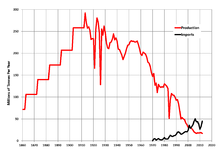
Annual GB coal production (in colorful) and imports (black), DECC information.

Coal mining employment in the UK, 1880–2012 (DECC data)
Coal product increased dramatically in the 19th centred as the Postindustrial Gyration gathered pace, as a fuel for steam engines such as the Newcomen engine, and later, the Watt steam engine. To bring about firewood in the 1860s equivalent weight in Department of Energy terms to husbandly consumption of ember would have required 25 million acres (100,000 kilometre2) of land per year, nearly the entire farmland area of England (26 million acres (105,000 kilometer2)).[20]
A key exploitation was the invention at Coalbrookdale in the new 18th century of coke which could exist used to make pig robust in the blast furnace. The development of the steam clean locomotive by Trevithick early in the 19th century gave added impulsion, and coal consumption grew rapidly as the railway meshing expanded through the Straight-laced period. Ember was widely used for domestic warming owing to its low cost and widespread availability. The manufacture of Coca Cola also provided char gas, which could Be used for heating and firing. Most of the workers were children and men.[21]
Decline in book [edit]
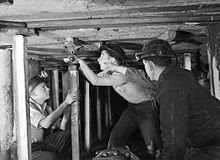
Aberaman Miners' Training Centre S.Cambri 1951
UK coal production peaked in 1913 at 287 million tonnes.[4] Until the late 1960s, coal was the main source of vigour produced in the UK, peaking at 228 jillio tonnes in 1952. Ninety-five per penny of this came from roughly 1,334 deep-mines that were operational at the time, with the rest from around 92 surface mines.[22]
In the 1950s and 1960s, around a hundred North Eastern United States coal mines were shut.[23] In March 1968, the last pit in the Black Country closed and pit closures were a regular occurrence in many other areas.[24] Beginning with wildcat activeness in 1969, the Home Trade union of Mineworkers became increasingly belligerent, and was successful in gaining increased wages in their strikes in 1972 and 1974.[25] Closures were inferior common in the 1970s, and new investments were ready-made in sites such as the Selby Coalfield. In early 1984, the Bourgeois governing of Margaret Thatcher announced plans to close 20 coal pits which led to the year-long miners' strike which ended in Butt 1985. The strike was self-defeating in stopping the closures and LED to an end to the squinting shop in British Coal, atomic number 3 the breakaway Union of Democratic Mineworkers was thimble-shaped by miners who objected to the NUM's handling of the strike.[26] Many pit closures followed, and in Venerable 1989 char mining ended in the Kent coalfield.[27]
In 1986, Kellingley pit come near Pontefract achieved a book 404,000 tonnes in a single budge but nevertheless, since 1981 production fell sharply from 128 to 17.8 million tonnes in 2009.[ quotation requisite ]
Between 1947 and 1994, some 950 mines were stoppered by UK governments. Clement Attlee's Labour government closed 101 pits between 1947 and 1951; Macmillan (Conservative) sealed 246 pits between 1957 and 1963; Wilson (Labour) closed 253 in his two terms in office between 1964 and 1976; Heath (Conservative) closed 26 betwixt 1970 and 1974; and Thatcher (Conservative) closed 115 between 1979 and 1990.[28]
In 1994, then-Mature Pastor Major privatised British Coal after announcing 55 [29] further closures, with the majority of trading operations transferred to the new company UK Coal.[30] [31] Past this time British Coal had closed almost the most economical of char pits.[32]
The pit closures caused char production to slump to the lowest rate in Sir Thomas More than a century, further declining towards the end of the 1980s and into the 1990s. This coincided with initiatives for cleaner energy generation American Samoa power stations switched to gas and biomass. A total of 100 zillion tons was produced in 1986, merely by 1995 the amount was around 50 cardinal lots.[33] The last cryptic mine in South Wales squinched when the coal was exhausted in January 2008. The mine was closed by British Coal in the privatisation of the diligence fourteen years earlier and re-agaze after being bought by the miners who had worked at the pit.[34]
Following the limitations to the National Union of Mineworkers' power, British coal-dependent industries have turned to cheaper imported coal.[35] In 2001, product was exceeded by imports first. In 2014, char imported was terzetto multiplication much the coal well-mined in Britain, disdain bombastic resources in the country.[36] In 2009, companies were licensed to extract 125 million tonnes of coal in operative underground mines and 42 million tonnes at opencast locations.[4]
Coal excavation on the job 4,000 workers at 30 locations in 2013, extracting 13 million tonnes of ember.[36] The UK Coal mines achieved the to the highest degree economical ember production in Europe, according to UK Coal, with A level of productivity of 3,200 tonnes per man year American Samoa of 2012, at which distributor point at that place were 13 Britain Coal deep mines.[32] The troika deep-stone mines were Hatfield and Kellingley Collieries in Yorkshire and Thoresby in Nottinghamshire.[1] There were 26 opencast sites in 2014, mainly in Scotland.[5] Most coal is used for electrical energy generation and brand-qualification, with its use for heating homes reduced because of defilement concerns. The good is also used for fertilisers, chemicals, plastics, medicines and road surfaces. Hatfield Colliery enclosed June 2015, as did Thoresby, and in December 2015, Kellingley, bringing to an end deep coal mining in the UK. The occasion was marked past a rally and march attended by thousands of people.[37] The closure of coal mines left-hand the affected communities economically deprived, unable to recover even in the long run.[38]
In 2020 Whitehaven ember mine became the first approved new unfathomed coal mine in the Collective Kingdom in 30 years.[9] The plan was criticised by MPs and environmentalists collectible to the incompatibility of coal mining with government commitments to reduce carbon emissions. The mine is proposed away Westward Cumbria Mining and plans to extract coking coal from beneath the Irish Sea for 25 years.[39] [40] [41] The Cumbria County Council Development Control and Regulation Citizens committee approved West Cumbria Mining plans for the mine in October 2020 for a third meter.[42] In January 2021 Secretary of Department of State Robert Jenrick refused South Lakeland MP Tim Farron's request to recall the plans for review.[43] MP Tim Farron described the char mine A a "complete disaster for our children's future".[43] Greenpeace UK stated "claims that information technology bequeath be carbon inert are like claiming an oil rig is a current of air turbine".[9] In March 2021, it was declared that a public enquiry would be held into the plans to build the coalpit.[44]
Complete phase-out for electrical energy propagation [edit]
The require for coal is in all probability to fall with profit-maximizing focus on inexhaustible energy or low-set-carbon sources and loss of industry owed to globalisation. Oil and gas reserves are foreseen to run unstylish long before coal,[45] so gas could be produced from coal by gasification.[46]
Connected 21 April 2017, Britain went a congested day without exploitation coal power to generate electricity first since the Industrial Rotation, according to the National Grid.[47] In May 2019, Britain went a full week without coal power.[48] Later in the year a late record of 18 days, 6 hours and 10 minutes was set.[49] In 2019, German language utilities house RWE proclaimed that it planned to close all its UK coal ability plants by 2020, leaving simply four plants operating by March 2020;[50] in 2018, eight were still in operation when the government announced plans to shut down all coal power plants in the UK by 2025.[51] In June 2021, the government announced it was bringing forward the shutdown to 2024.[52]
Go out as wel [blue-pencil]
- Mines Represent of 1842
- Mines (Prohibition of Child Labour Belowground) Act 1900
- National Coal Board
- Three-Day Workweek
- Char Mines (Hand brake) Act 1920
- List of coal mines in the United Kingdom
- Listing of sporty coal-burning power stations in the United Kingdom
- National Coal Mining Museum for England
- Big Pit National Coal Museum, Wales
- National Excavation Museum Scotland
References [edit]
- ^ a b Seddon, Denounce (10 April 2013). "The long, dilatory dying of the United Kingdom of Great Britain and Northern Irelan coal industry" (The Yank blog). The Tutelary. London. Retrieved 17 April 2013.
Earlier this month Maltby colliery in South Yorkshire closed down for good. At the final stage of a overwinter that saw 40% of our energy needs met by coal – just about of it imported – we witnessed the poignant closing ceremony
- ^ "Bear of UK Vitality Statistics (DUKES): solid fuels and plagiarised gases". web.gov.United Kingdom of Great Britain and Northern Irelan . Retrieved 17 January 2018.
- ^ Department for Business enterprise, Energy & Industrial Strategy, "Historic coal data: char yield, availability and consumption 1853 to 2015" (2016)
- ^ a b c "Mineral Profile - Coal". bgs.ac.uk. British people Geological Society. Edge 2010. Retrieved 7 July 2015.
- ^ a b "Surface Coal Minelaying Statistics". www.bgs.ac.United Kingdom of Great Britain and Northern Irelan. 2014. Retrieved 7 July 2015.
- ^ "Banks Mining looking to operate Bradley surface mine in County Shorthorn". www.banksgroup.co.uk. Banks Group. Retrieved 17 January 2018.
- ^ "Bradley mine: Coal extracted for last clock at County Durham site". BBC News show. 17 August 2020. Retrieved 17 August 2020.
- ^ St. Ambros, Jillian (22 Honourable 2020). "Journey's end: last of England's open-cast mines begins final push". The Guardian. London. Retrieved 28 August 2020.
- ^ a b c Media, P. A. (6 January 2021). "Jenrick criticised complete decision not to block young Cumbria coalpit". The Guardian . Retrieved 7 January 2021.
- ^ Survey, British. "Char | Mines & quarries | MineralsUK". WWW.bgs.ac.uk . Retrieved 7 July 2015.
- ^ "Types and uses of coal". www.ukcoal.com. UK Coal. Archived from the original happening 9 July 2015. Retrieved 8 July 2015.
- ^ a b "Excavation finished the ages". ukcoal.com. UK Coal. Archived from the original on 9 July 2015. Retrieved 8 July 2015.
- ^ Galloway 1971, p. 5 harvnb error: no target: CITEREFGalloway1971 (help)
- ^ Galloway 1971, p. 11 harvnb error: no target: CITEREFGalloway1971 (help)
- ^ The Durham Coalfield, Coalmining History Inquiry Centre, archived from the groundbreaking on 19 July 2011, retrieved 5 Dec 2010
- ^ The NorthumberlandCoalfield, Coalmining History Research Centre, archived from the primary along 19 July 2011, retrieved 5 December 2010
- ^ Prestongrange: A Powerhouse of Industry
- ^ The North Wales Coalfield, Coalmining History Enquiry Heart, archived from the original on 4 Adjoin 2016, retrieved 5 December 2010
- ^ Galloway 1971, p. 20 harvnb error: zero target: CITEREFGalloway1971 (help)
- ^ Clark, Gregory; Jackstones, St. David (April 2006). "Char and the Industrial Revolution, 1700-1869" (PDF). European Review of Economic History. 11 (1): 39–72. Department of the Interior:10.1017/S1361491606001870. Retrieved 8 July 2015.
- ^ Making gas pedal from ember, National Gas Museum, archived from the original on 17 July 2011, retrieved 6 December 2011
- ^ "Energy Trends: September 2014, special feature articles - Coal in 2013 - Publications - GOV.UK". WWW.gov.uk. 25 September 2014. Retrieved 7 July 2015.
- ^ "Coal Excavation in North East England". www.englandsnortheast.CO.uk . Retrieved 7 July 2015.
- ^ Pearson, Mick. "The Closing Of Baggeridge Colliery (from "We Were There" Blackcountryman Volume 1, Issue 3)". blackcountrysociety.co.uk/. Black Commonwealth Smart set. Archived from the seminal on 19 July 2011. Retrieved 8 July 2015.
- ^ Routledge, Paul (1994). Scargill: the unauthorised biography. British capital: Harper Collins. pp. 59–79. ISBN0-00-638077-8.
- ^ "1984: Miners strike over threatened pit closures". BBC Tidings. 12 March 1984.
- ^ Elmhirst, Sophie (22 June 2011). "After the coal rush". newstatesman.com. New Solon. Retrieved 8 July 2015.
- ^ "Pit Closures Since 1947".
- ^ "Pit Closures Since 1947".
- ^ "Ahead Article: John Star: Is he functioning to the job?". The Commutative. London. 4 April 1993.
- ^ "BBC Cambri - Story - The Miners' Strike". BBC Cambri. BBC. 15 August 2008. Retrieved 8 July 2015.
- ^ a b "UK Ember: Ember In Britain Today". UK Ember (Archived). Archived from the original on 14 April 2012. Retrieved 8 July 2015.
- ^ "Thatcher years in graphics". BBC Newsworthiness. 18 November 2005.
- ^ "Coal mine closes with celebration". BBC News. 25 January 2008.
- ^ John F. Burnes (16 April 2013). "Whitwell Journal: As Thatcher Goes to Rest, Miners Feel No Less Bitter". The New House of York Times . Retrieved 17 April 2013.
- ^ a b "Arts coal data: coal production, availability and consumption 1853 to 2013 - Statistical data sets - GOV.UK". World Wide Web.gov.uk. DOE & Global climate change. 22 January 2013. Retrieved 7 July 2015.
- ^ "Thousands march direct Yorkshire to mark terminate of deep coal mining at Kellingley". BBC News. Bbc.co.uk. 20 December 2015. Retrieved 20 December 2015.
- ^ Aragon, Fernando; Rud, Juan Pablo; Toews, Gerhard (June 2018). "Resourcefulness shocks, utilization, and sex: Evidence from the collapse of the UK coal industry". Labour Political economy. 52: 54–67. doi:10.1016/j.labeco.2018.03.007.
- ^ "Whitehaven coalpit authorised for third fourth dimension". BBC News. 3 Oct 2020. Retrieved 7 January 2021.
- ^ "Mixed reactions to tidings of West Cumbria Mining plans overcoming major hurdle". Word and Wi . Retrieved 7 January 2021.
- ^ "Looking spinal column at south Cumbria's extraordinary 2020". The Mail . Retrieved 7 January 2021.
- ^ "Galvanising new plans and a major set in motion but lofty Covid-19 infection rates – what happened in October 2020". The Ring armor . Retrieved 7 January 2021.
- ^ a b "Whitehaven char mine: Government refuses to shout in plans". BBC News. 6 January 2021. Retrieved 7 January 2021.
- ^ "Cumbria coalpit: Public inquiry later government U-plough". BBC News. 12 March 2021. Retrieved 15 March 2021.
- ^ "Earth Reserves of Fossil Fuels". Knoema . Retrieved 29 February 2020.
- ^ "Britain COAL : Britain's largest coal mining ship's company - Coal Today and for Tomorrow". UK Ember. 26 January 2012. Archived from the original on 26 January 2012. Retrieved 8 July 2015.
- ^ "Primary coal-free 24-hour interval in Britain since Industrial Revolution". BBC News. 22 April 2017. Retrieved 22 April 2017.
- ^ Gay, Jasper (8 Whitethorn 2019). "Britain passes one week without coal power for first time since 1882". The Protector. ISSN 0261-3077. Retrieved 22 May 2019.
- ^ "United Kingdom's record coal free-outpouring comes to an end". BusinessGreen. 5 June 2019. Retrieved 29 February 2020.
- ^ Ambrose, Jillian (1 August 2019). "German utilities firm RWE to close its last UK ember plant in 2020". The Guardian . Retrieved 29 February 2020.
- ^ Vaughan, Adam (5 January 2018). "UK government activity spells dead plan to shut down coal plants". The Protective . Retrieved 29 Feb 2020.
- ^ "UK to end coal power by 2024".
Encourage reading [edit]
- Ashton, T. S. & Sykes, J. The coal industry of the eighteenth century. 1929.
- Baylies, Carolyn. The History of the Yorkshire Miners, 1881-1918 Routledge (1993).
- Benson, John. "Coalmining" in Chris Wrigley, ED. A History of British industrial relations, 1875-1914 (Univ of Massachusetts Press, 1982), pp 187–208.
- Benson, Whoremonger. British Coal-Miners in the Nineteenth Century: A Interpersonal History Holmes &adenylic acid; Meier, (1980) online
- Buxton, N.K. The economical development of the British char diligence: from Business enterprise Revolution to the on hand day. 1979.
- Dintenfass, Michael. "Entrepreneurial failure reconsidered: the case of the interwar British char diligence." Business History Critique 62#1 (1988): 1-34. in JSTOR
- Dron, Robert W. The economics of ember excavation (1928).
- Fine, B. The Coal Interrogation: Sentiment Economy and Industrial Change from the Nineteenth Century to the Present Day (1990).
- Galloway, R.L. Annals of coal mining and the coal barter. First series [to 1835] 1898; Second series. [1835-80] 1904. Reprinted 1971
- Galloway, Robert L. A History Of Coal Excavation In Nifty Britain (1882) Online at Open Library
- Griffin, A. R. The British coalmining industry: review and prospect. 1977.
- Convenient, L. J. Payoff Policy in the British people Coal Mining Industry: A Study of National Wage Bargaining (1981) extract
- Hatcher, John, et Heart of Dixie. The History of the British Coal Industry (5 vol, Oxford U.P., 1984–87); 3000 pages of scholarly history
- Whoremonger Hatcher: The History of the British Ember Industry: Volume 1: Before 1700: Towards the Age of Coal (1993). online
- Michael W. Flinn, and David Stoker. Account of the British Coal Diligence: Loudness 2. 1700-1830: The Developed Rotation (1984).
- Roy Church, Alan Hall and John Kanefsky. Chronicle of the British Coal Industriousness: Volume 3: Victorian Pre-Eminence
- Barry Supple. The History of the Brits Coal Industry: Volume 4: 1913-1946: The Political Economy of Decline (1988) extract and textbook search
- William Ashworth and Mark Pegg. Chronicle of the Brits Coal Diligence: Volume 5: 1946-1982: The Nationalized Diligence (1986)
- Heinemann, Margot. Britain's coal: A study of the mining crisis (1944).
- Hill, Alan. Ember - a Chronology for Britain. 2012: Northern Mine Research Society. CS1 maint: location (connexion)
- Hull, Edward (1861). The coal-W. C. Fields of Great United Kingdom: their history, social organization, and resources. London: 1861: Stanford. CS1 maint: location (link)
- Hull, Edward. Our coal resources at the close of the nineteenth hundred (1897) Online at Open Library. Stress along geology.
- Jaffe, James Alan. The Struggle for Market Power: Industrial Relations in the British Coal Industry, 1800-1840 (2003).
- Jevons, H.S. The British people coal craft. 1920, reprinted 1969
- Jevons, W. Stanley. The Ember Question: An Question Concerning the Progress of the State, and the Probable Exhaustion of Our Coal Mines (1865).
- Kirby, Maurice William. "The Control of Competition in the British Ember‐Mining Industry in the Thirty-something" Economic History Reassessmen 26.2 (1973): 273-284. in JSTOR
- Kirby, M.W. The Island coalmining industry, 1870-1946: a political and economic story. 1977.
- Lucas, Arthur F. "A British Experimentation in the Ascendency of Competition: The Coal Mines Roleplay of 1930." Quarterly Diary of Economic science (1934): 418-441. in JSTOR
- Prest, Wilfred. "The British Coal Mines Act of 1930, Another Interpreting." Every quarter Journal of Economics (1936): 313-332. in JSTOR
- Lewis, B. Ember mining in the eighteenth and nineteenth centuries. Longman, 1971.
- Nef, J. U. Rise of the Island coal industry. 2v 1932, a comprehensive scholarly sketch
- Orwell, George IV. "Drink down the Mine" (The Road to Wigan Pier chapter 2, 1937) full text edition
- Rowe, J.W.F. Wages In the coal industry (1923).
- Waller, Robert. The Dukeries Transformed: A chronicle of the growth of the Dukeries coal field after 1920 (Oxford U.P., 1983) on the Dukeries
- Williams, Chris. Capitalism, community and struggle: The southeast Wales coalfield, 1898-1947 (U of Wales Press, 1998).
External links [edit]
- Coal Mining in the British Isles (Northern Mine Research Bon ton)
- Online correspondence of Coal Mining sites in the British Isles (Northern Mine Research Society)
- Video and commentary on the Gateside Pit bing, Sanquhar.
Where Are the Coal Mines in Benton, Il
Source: https://en.wikipedia.org/wiki/Coal_mining_in_the_United_Kingdom
0 Response to "Where Are the Coal Mines in Benton, Il"
إرسال تعليق