Families Grouped Into Clusters of Ten Is Part of the _______ System.
NAEYC has set 10 standards for early childhood programs that tin assist families brand the right selection when they are looking for a kid care center, preschool, or kindergarten. The standards and criteria are besides the foundation of the NAEYC Accreditation system for early childhood programs. To earn accreditation, programs must meet all 10 standards.
Based on research on the development and education of young children, the standards were created with input from experts and educators from effectually the country. The standards define what NAEYC—the world's largest organization of early on childhood professionals—believes all early on childhood programs should provide.
Review this guide to aid identify programs that meet NAEYC standards for loftier-quality programs.
The Standards
- Standard 1: Relationships
- Standard ii: Curriculum
- Standard 3: Teaching
- Standard 4: Assessment of Child Progress
- Standard v: Health
- Standard 6: Staff Competencies, Preparation, and Support
- Standard seven: Families
- Standard eight: Customs Relationships
- Standard 9: Concrete Environment
- Standard 10: Leadership and Management
Standard 1: Relationships
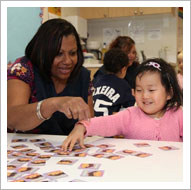 The program promotes positive relationships among all children and adults. It encourages each child's sense of individual worth and belonging as role of a community and fosters each child's power to
contribute as a responsible customs member.
Warm, sensitive, and responsive relationships assist children feel secure. The safety and secure environments built by positive relationships assist children thrive physically, benefit from learning experiences, and cooperate and go forth with others.
What to look for in a programme:
- Children and adults feel welcome when they visit the program. Teachers help new children suit to the program environment and make friends with other children.
- Teaching staff appoint in warm, friendly conversations with the children and encourage and recognize children'southward work and accomplishments.
- Children are encouraged to play and piece of work together.
- Teachers help children resolve conflicts by identifying feelings, describing problems, and trying culling solutions. Teaching staff never physically punish children.
Back to acme
Standard 2: Curriculum
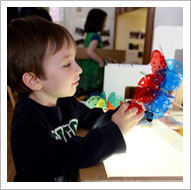 The program implements a curriculum that is consistent with its goals for children and promotes learning and development in each of the post-obit areas: social, emotional, concrete, language, and cerebral.
A well-planned written curriculum provides a guide for teachers and administrators. Information technology helps them work together and balance dissimilar activities and approaches to maximize children's learning and evolution. The curriculum includes goals for the content that children are learning, planned activities linked to these goals, daily schedules and routines, and materials to be used.
NAEYC and the NAEYC Accreditation arrangement do non prescribe a specific curriculum; programs can design their own or choose a commercially available curriculum that meets NAEYC'due south guidelines.
What to look for in a program:
- Ask about the plan's curriculum and how it addresses all aspects of child development. The curriculum should non focus on simply one area of evolution.
- Children are given opportunities to learn and develop through exploration and play, and teachers have opportunities to work with individual children and small groups on specific skills.
- Materials and equipment spark children'south interest and encourage them to experiment and acquire.
- Activities are designed to assistance children go better at reasoning, solving problems, getting along with others, using linguistic communication, and developing other skills.
- Infants and toddlers play with toys and art materials that "do something" based on children'south actions, such every bit jack-in-the-box, cups that fit inside one another, and playdough.
Back to peak
Standard 3: Instruction
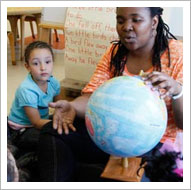 The program uses developmentally, culturally, and linguistically appropriate and effective teaching approaches that enhance each child's learning and development in the context of the curriculum goals.
Children have different learning styles, needs, capacities, interests, and backgrounds. By recognizing these differences and using instructional approaches that are appropriate for each child, teachers and staff help all children learn.
What to look for in a program:
- Teachers carefully supervise all children.
- Teachers provide time each day for indoor and outdoor activities (weather permitting) and organize time and space so that children take opportunities to work or play individually and in groups.
- Children's recent piece of work (for example, art and emergent writing) is displayed in the classroom to assist children reflect on and extend their learning.
- Teachers change strategies and materials to respond to the needs and interests of individual children, engaging each child and enhancing learning.
Dorsum to elevation
Standard 4: Assessment of Kid Progress
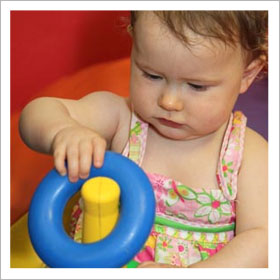 The program is informed past ongoing systematic, formal, and informal assessment approaches to provide information on children's learning and development. These assessments occur within the context of reciprocal communications with families and with sensitivity to the cultural contexts in which children develop.
Assessment results do good children past informing sound decisions, teaching, and plan improvement.
Assessments assist teachers plan appropriately challenging curriculum and tailor educational activity that responds to each child'south strengths and needs. Assessments tin can also assist teachers identify children with disabilities and ensuring that they receive needed services.
What to await for in a program:
- The program supports children's learning using a diversity of assessment methods, such as observations, checklists, and rating scales.
- Assessment methods are appropriate for each kid's age and level of development and encompass all areas of development, including math, scientific discipline, and other cognitive skills; linguistic communication; social-emotional; and concrete.
- Teachers utilise assessment methods and data to pattern goals for individual children and monitor their progress, besides as to ameliorate the plan and its education strategies.
- Families receive information about their kid'due south development and learning on a regular basis, including through meetings or conferences.
Back to top
Standard 5: Wellness
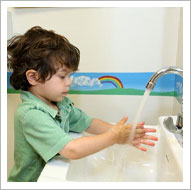 The program promotes the diet and health of children and protects children and staff from illness and injury. Children must exist healthy and safe in order to learn and grow. Programs must be healthy and safe to support children's healthy development.
What to await for in a plan:
- Teaching staff accept training in pediatric first aid.
- Infants are placed on their backs to sleep.
- The program has policies regarding regular hand washing and routinely cleans and sanitizes all surfaces in the facility.
- There is a clear program for responding to disease, including how to decide whether a child needs to go home and how families will be notified.
- Snacks and meals are nutritious, and nutrient is prepared and stored safely.
Back to top
Standard 6: Staff Competencies, Preparation, and Support
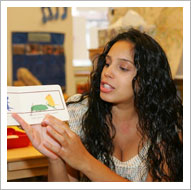 The program employs and supports a didactics staff with the educational qualifications, knowledge, and professional commitment necessary to promote children's learning and development and to support families' diverse needs and interests.
Teachers who have specific preparation, knowledge, and skills in child development and early childhood didactics are more likely to provide positive interactions, richer language experiences, and quality learning environments.
What to look for in a plan:
- Didactics staff have educational qualifications and specialized noesis nearly young children and early childhood development. Ask, for case, how many teachers have Child Development Acquaintance (CDA) credentials, associate's degrees, or higher degrees.
- The program makes provisions for ongoing staff development, including orientations for new staff and opportunities for standing education.
- Teaching staff have training in the plan's curriculum and work every bit a pedagogy squad.
Back to summit
Standard vii: Families
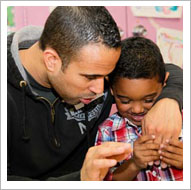 The program establishes and maintains collaborative relationships with each child'south family to foster children's development in all settings. These relationships are sensitive to family composition, language, and culture. To support children's optimal learning and development, programs need to establish relationships with families based on mutual trust and respect, involve families in their children'south educational growth, and encourage families to fully participate in the program.
What to look for in a program:
- All families are welcome and encouraged to exist involved in all aspects of the plan.
- Teachers and staff talk with families most their family construction and their views on childrearing and employ that information to adapt the curriculum and teaching methods to the families served.
- The program uses a variety of strategies to communicate with families, including family conferences, new family orientations, and individual conversations.
- Programme data—including policies and operating procedures—is provided in a linguistic communication that families can understand.
Back to top
Standard 8: Customs Relationships
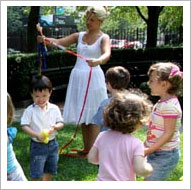 The programme establishes relationships with and uses the resources of the children's communities to support the accomplishment of plan goals. Relationships with agencies and institutions in the community can help a program accomplish its goals and connect families with resource that support children's good for you evolution and learning.
What to look for in a program:
- The programme connects with and uses museums, parks, libraries, zoos, and other resources in the community.
- Representatives from community programs, such as musical performers and local artists, are invited to share their interests and talents with the children.
- The staff develop professional person relationships with community agencies and organizations that further the programme'southward capacity to encounter the needs and interests of children and families.
Dorsum to acme
Standard ix: Concrete Environment
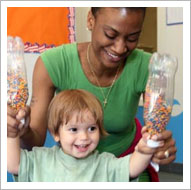 The plan has a condom and healthful environment that provides advisable and well-maintained indoor and outdoor concrete environments. The environment includes facilities, equipment, and materials to facilitate kid and staff learning and evolution.
An organized, properly equipped, and well-maintained program surroundings facilitates the learning, comfort, health, and safety of the children and adults who use the programme.
What to await for in a programme:
- The facility is designed so that staff tin can supervise all children by sight and sound.
- The plan has necessary furnishings, such as hand-washing sinks, child-size chairs and tables, and cots, cribs, beds, or sleeping pads.
- A diverseness of materials and equipment appropriate for children's ages, skills and abilities is available and kept clean, prophylactic, and in expert repair.
- Outdoor play areas have fences or natural barriers that preclude access to streets and other hazards.
- Kickoff-assistance kits, burn down extinguishers, fire alarms, and other safety equipment are installed and bachelor.
Back to top
Standard 10: Leadership and Management
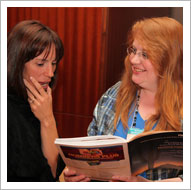 The program effectively implements policies, procedures, and systems that support stable staff and strong personnel, and fiscal, and program direction so all children, families, and staff accept loftier-quality experiences.
Effective direction and operations, knowledgeable leaders, and sensible policies and procedures are essential to building a quality program and maintaining the quality over fourth dimension.
What to look for in a program:
- The program ambassador has the necessary educational qualifications, including a degree from a four-year college and specialized courses in early childhood educational activity, child development, or related fields.
- The program is licensed and/or regulated by the applicable state agency.
- The program'south written policies and procedures are shared with families and address issues such as the program's philosophy and curriculum goals, policies on guidance and discipline, and wellness and rubber procedures.
- Appropriate group sizes and ratios of teaching staff to children are maintained (for example, infants—no more 8 children in a group, with two teaching staff; toddlers—no more than 12 children in a grouping, with 2 teaching staff; and 4-year-olds—no more than 20 children in a grouping, with 2 teaching staff).
Back to top
Families on NAEYC-Accredited programs
"Valued teachers lead to valued children … Accredited programs tend to attract employees who not only view themselves as educators, they consider themselves child advocates."
— Kate in San Antonio, Texas. Her child attends an NAEYC-Accredited program.
"Choosing a preschool for my start child was somewhat overwhelming, so when you detect a program accredited by NAEYC, it adds peace of mind that you're making a good option for your child."
— Jen in Torrance, California. Her child attends an NAEYC-Accredited program.
"NAEYC is an organization that can exist trusted with the future of my kid's education … That is why I chose an NAEYC-Accredited eye—zilch simply the best."
— Jennifer in Newark, New Jersey. Her child attends an NAEYC-Accredited programme.
Source: https://www.naeyc.org/our-work/families/10-naeyc-program-standards
0 Response to "Families Grouped Into Clusters of Ten Is Part of the _______ System."
إرسال تعليق